Both the NVIDIA H100 and A100 are high-performance computing cards designed specifically for high-performance computing and data center applications. As major companies are currently training and developing their own large language models, these models will become a key competitive advantage for businesses in the future. Both cards share the following characteristics:
1. NVIDIA GPU Architecture: Both the A100 and H100 are designed based on NVIDIA’s GPU architecture, which means they incorporate NVIDIA’s leading graphics processing technology and architectural optimizations, delivering efficient, scalable, and reliable performance.
2. Massive Parallel Computing: The A100 and H100 are both designed for massive parallel computing, featuring powerful computational and processing capabilities that enable them to efficiently execute complex computational tasks.

3. Tensor Core Support: Both are equipped with Tensor Cores, which are crucial for machine learning and deep learning tasks. Tensor Cores accelerate matrix multiplication and deep learning computations, improving the efficiency of model training and inference.
4. AI Acceleration: Both the A100 and H100 are optimized for AI tasks, incorporating technologies such as support for low-precision and mixed-precision computing, as well as high-level parallelization, to deliver powerful AI acceleration performance.
5. High-Density Packaging: Both the A100 and H100 utilize NVIDIA’s proprietary high-density packaging technology. This technology allows the GPU’s core functional components and memory components to be packed more compactly onto a smaller chip, resulting in higher integration and performance.
6. Scalable GPU Architecture: Both the A100 and H100 utilize a scalable GPU architecture. This architecture delivers optimal processing capabilities and maximum performance density for various types of computational workloads, dynamically allocating and optimizing resources based on demand.
7. Optimized Memory Architecture: Both the A100 and H100 feature optimized memory architectures. They provide high-bandwidth memory access and caching mechanisms, delivering faster data read/write speeds and improved responsiveness when processing large-scale datasets.
8. Advanced Power Management Technology: Both the A100 and H100 feature advanced power management technology that intelligently adjusts to workload demands. This not only helps improve efficiency and energy savings but also ensures GPU stability during extended operation.
9. High-Performance Computing Support: Both the A100 and H100 are suitable for high-performance computing applications, capable of handling complex computational tasks such as large-scale scientific computing, simulations, and data analysis.

In addition to the shared features mentioned above, there are certain differences between the two, which are reflected in various parameters:
1. Number of CUDA Cores: The A100 has 6,912 CUDA cores, while the H100 has only 5,120 CUDA cores.
2. Number of Tensor Cores: The A100 has 432 Tensor cores, while the H100 has only 640 Tensor cores.
3. TeraFLOPS: The A100 delivers 19.5 TeraFLOPS of floating-point performance, while the H100 delivers 9.7 TeraFLOPS.
4. INT8 TOPS: The A100 delivers 312 TOPS of integer performance, while the H100 delivers 484 TOPS.
5. Memory Bandwidth: The A100 has a memory bandwidth of 1.6 TB/s, while the H100 has 900 GB/s.
6. VRAM Capacity: The A100 has 40 GB of VRAM, while the H100 has 32 GB.
7. Interface Type: The A100 uses a PCIe Gen4 x16 interface, while the H100 uses an NVLink interface.
In summary, the A100 offers superior computing power, featuring more CUDA cores, more Tensor cores, and higher floating-point and integer performance. However, the choice between these products depends on specific computing requirements and budget.
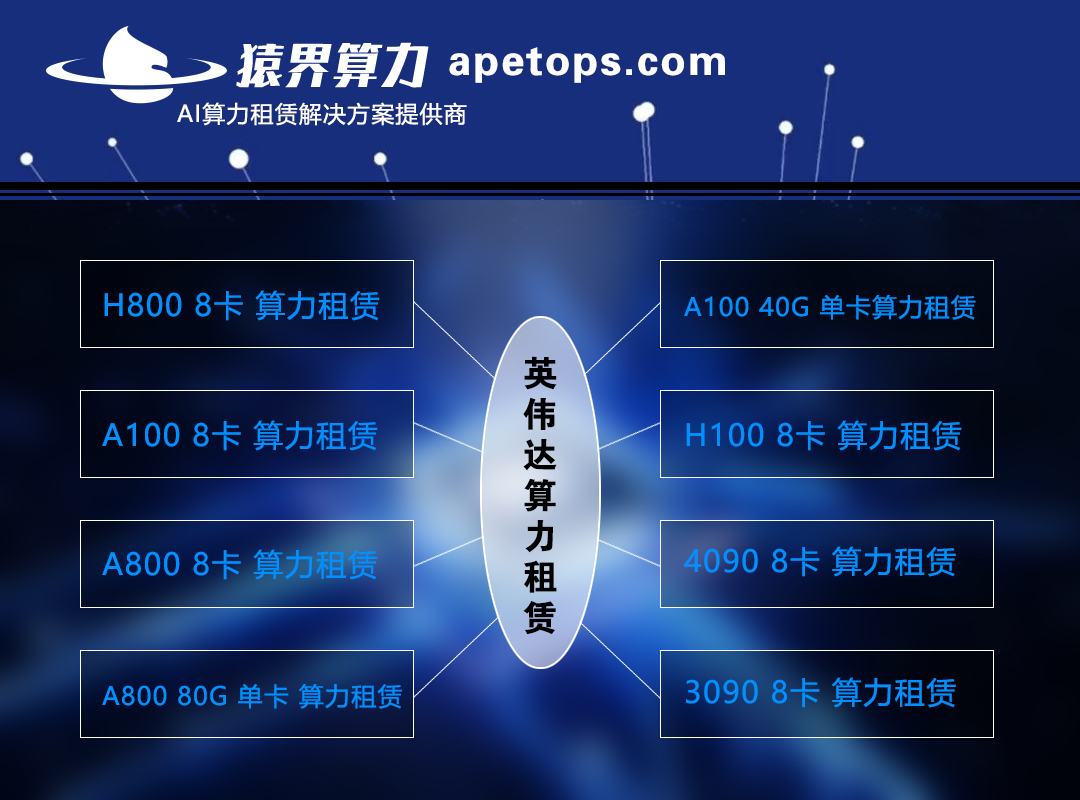
Yuanjie Computing Power - GPU Server Rental Provider
(Click the image below to visit the computing power rental introduction page)