In deep learning and AI applications, selecting the most suitable hardware is crucial for model training and inference tasks.
Especially when it comes to training large models, the NVIDIA 4090 may not be the best choice. Training tasks typically require larger VRAM capacity, higher memory bandwidth, and powerful computing capabilities. For these requirements, NVIDIA’s high-performance GPU series, such as the A100 and H100, are often better suited for handling large-scale datasets and complex models.

However, for inference tasks, the NVIDIA 4090 may offer better value for money compared to certain Intel H100 series processors. The memory and bandwidth requirements during the inference phase are relatively lower, and the 4090’s computational power may deliver higher performance and efficiency. This means that for inference tasks, the 4090 GPU may be capable of handling more complex models while offering superior value for money.
Furthermore, if the NVIDIA 4090 is optimized to its full potential, its cost-effectiveness could potentially be twice that of the H100. This implies that through in-depth optimization of the 4090 GPU, greater performance gains can be achieved in inference tasks while maintaining a more competitive price point.

So, what exactly is the difference between the 4090 and the H100?
For example, the RTX 4090 has higher clock speeds than the H100, as higher frequencies provide stronger graphics rendering capabilities. The H100’s strengths, however, lie in theoretical computing power, VRAM capacity, and memory bandwidth. This is because both AI inference and training heavily rely on data throughput efficiency, which is why the H100 requires expensive HBM3 memory.
Yuanjie Computing has learned that test results show that, aside from the A100/H100 series, the RTX 4090 Turbo leads by a wide margin in relative training throughput for both FP32 and FP16. However, the RTX 4090 is not suitable for training large models.but for inference (inference/serving), the 4090 is not only viable but also offers comparable cost-effectiveness to the H100. In fact, the biggest difference between the H100/A100 and the 4090 lies in communication and memory; the gap in computational power is not significant.

Therefore, while the NVIDIA 4090 may not be ideal for training large models, it offers better value for money than the H100 in inference.
Of course, specific performance and cost analyses must be based on the task’s requirements and scale. We recommend that users consult NVIDIA’s official spec sheets, performance test data, and actual cost-effectiveness comparisons provided by service providers to make informed decisions regarding purchasing and deployment.
As for the rental price of the 4090, the computing power market is currently quite volatile, and prices are unstable. Based on last week’s reference prices, the rental cost for an 8-card 4090 setup is approximately 13,500 RMB per month per unit, though specific rates are subject to the computing power rental provider.
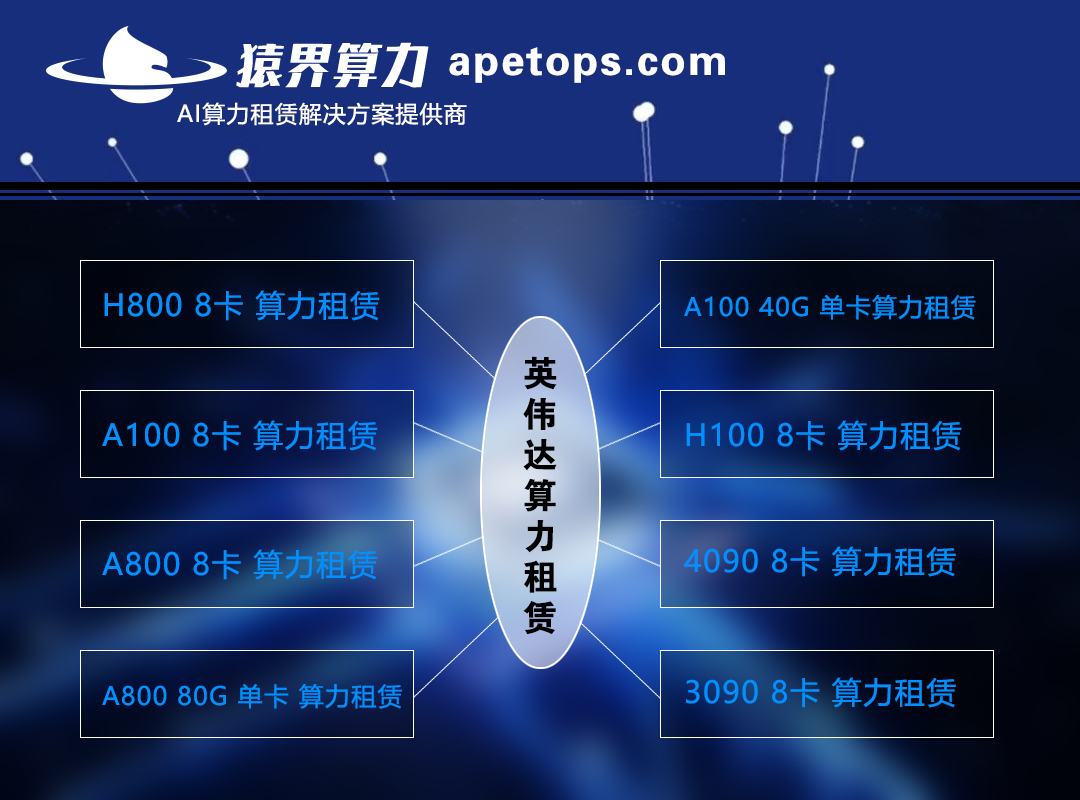
You may want to explore Yuanjie Computing Power Rental Services, which offers extensive resource channels, has state-owned capital backing, and provides reliable reputation and after-sales support. It’s worth checking out.
Yuanjie Computing Power – GPU Server Rental Provider
(Click the image below to visit the computing power rental introduction page)